 Back to all buyer's guides
Dynamo or alternator – what's the difference?
Both do the same job: they turn the engine's rotation into the current that charges the battery. But they do it in completely different ways – and if you order the wrong part, it won't fit. Here we sort out the terms in five minutes.
Direct current vs alternating current
The words are often confused – in everyday speech both are sometimes called a "dynamo". Technically the difference is clear.
The dynamo is a direct-current generator. It produces direct current straight away using a commutator – a split copper ring that the brushes run against. The dynamo was fitted to tractors, cars and machines roughly up until the late 1960s, often in 6-volt systems.
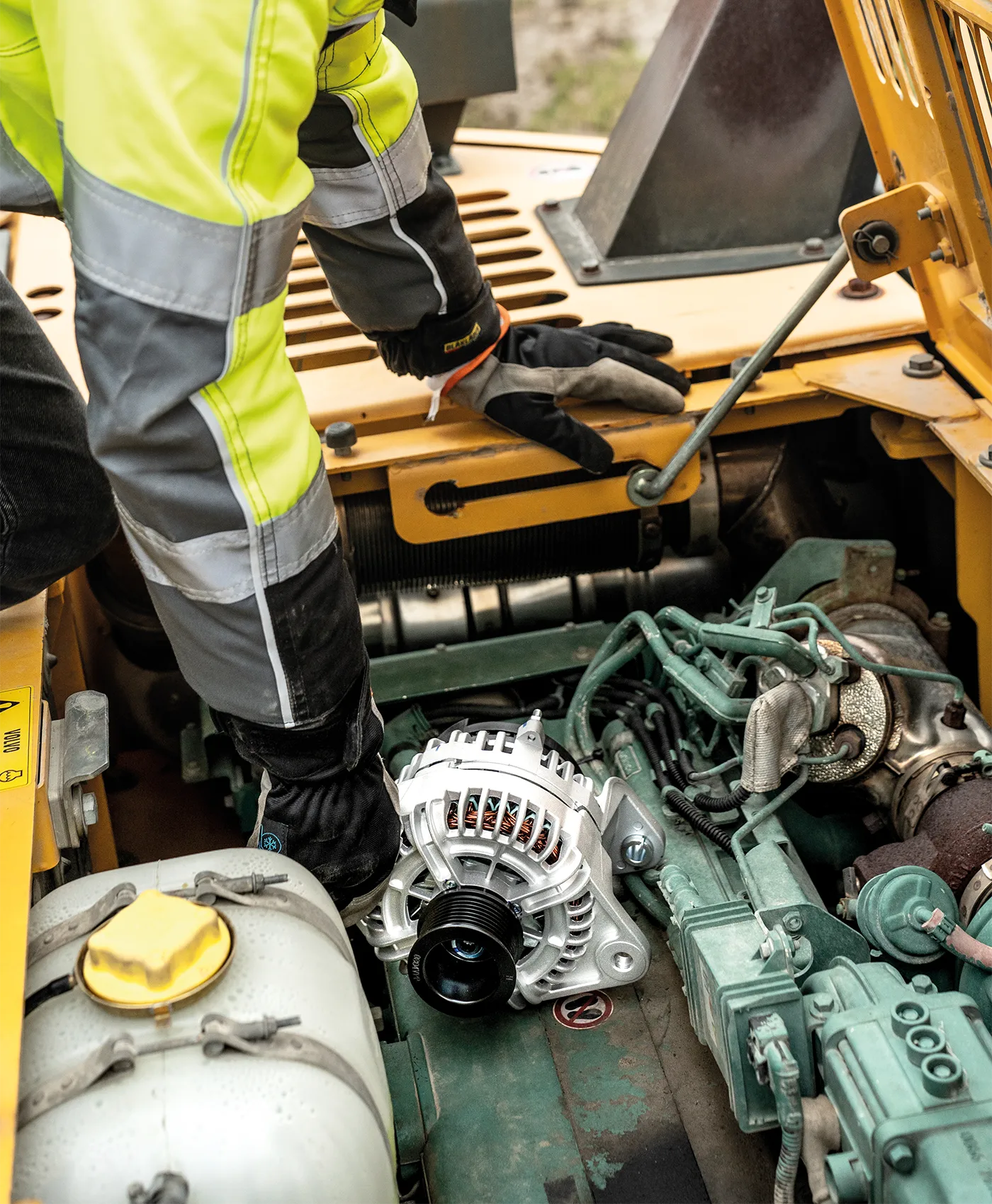
The alternator produces alternating current that is rectified into direct current by diodes. It became widespread during the 1960s and 70s, delivers considerably more current – especially at idle – and is fitted to practically every modern vehicle and machine.
Comparison at a glance
The table sums up the practical differences – what you notice in the workshop and out in the field.
| Property | Dynamo | Alternator |
|---|---|---|
| Current type | Direct current straight from a commutator | Alternating current rectified by diodes |
| Era | Common up to around the 1960s–70s | Standard on everything modern |
| System voltage | Often 6 V, sometimes 12 V | 12 V (or 24 V on larger machines) |
| Charging at idle | Weak or none – needs revs | Charges already at idle |
| Output | Low, often under 200 W | High – handles lighting, cab and electronics |
| Regulator | Separate charging relay on the bodywork | Usually a built-in voltage regulator |
| Maintenance | Brushes and commutator wear, needs attention | Largely maintenance-free, bearings and brushes rarely replaced |
| Weight and size | Long, smooth cylinder – heavy for its output | Compact, with ventilation openings and a fan |
How do I know which one my machine has?
Open the bonnet and look at the unit driven by the V-belt. Three things give it away straight away.
-
The shape
A dynamo is a long, smooth and almost fully enclosed cylinder. An alternator is shorter, chunkier and has clear ventilation openings in the end covers.
-
The regulator
Is there a separate charging relay (a metal box with several cable connections) mounted on the wing or the bulkhead? Then you most likely have a dynamo. Alternators usually have the regulator built in.
-
Model year and voltage
If the machine was built before the mid-1960s and has a 6-volt system, everything points to a dynamo. From the 1970s onwards it's almost always an alternator and 12 volts.
Can you replace a dynamo with an alternator?
Yes – it's one of the most common upgrades on vintage tractors, and often well worth the effort.
With an alternator the battery charges even at idle, you get enough power for better work lighting, and the cold-morning starting problems usually disappear. If you switch from 6 to 12 volts at the same time, the battery, bulbs, ignition coil and possibly the starter motor need to be reviewed so the whole system matches.
For many classic tractor models there are complete conversion kits with alternator, brackets and pulley – turning the job into an afternoon's work rather than an engineering project.
FAQ / Frequently asked questions
Are a dynamo and an alternator the same thing?
No. Both convert motion into electricity, but the dynamo produces direct current directly via a commutator, whereas the alternator produces alternating current that is rectified by diodes. In everyday speech the words are sometimes used interchangeably, which causes trouble when ordering spare parts – always check what is actually fitted to the machine.
Why isn't my dynamo charging?
The most common causes are worn brushes, a dirty or worn commutator, a faulty charging relay or a slipping V-belt. A dynamo that has stood still for a long time may also have lost its residual magnetism and need to be "re-polarised" before it charges again.
Start by checking the belt tension and the cables – that solves a surprising number of cases.
What do D+, DF and B+ on the terminals mean?
These are standard designations for the charging system's terminals: B+ is the main current to the battery, D+ is the charge indicator (the charge lamp) and DF is the field winding's control current. On older dynamo systems, DF and D+ run to the separate charging relay.
Can I drive with a faulty alternator?
A short distance, yes – the machine runs on the battery until it is discharged. But you risk being stranded, and an alternator that has failed due to seized bearings can, in the worst case, damage the belt. Replace or recondition it as soon as possible.
Which alternator fits my tractor?
Start from the tractor's model and engine number. Check the voltage (6/12/24 V), output, pulley type and mounting design. Search for your tractor model with us and you'll see which dynamos, alternators, regulators and brushes fit.
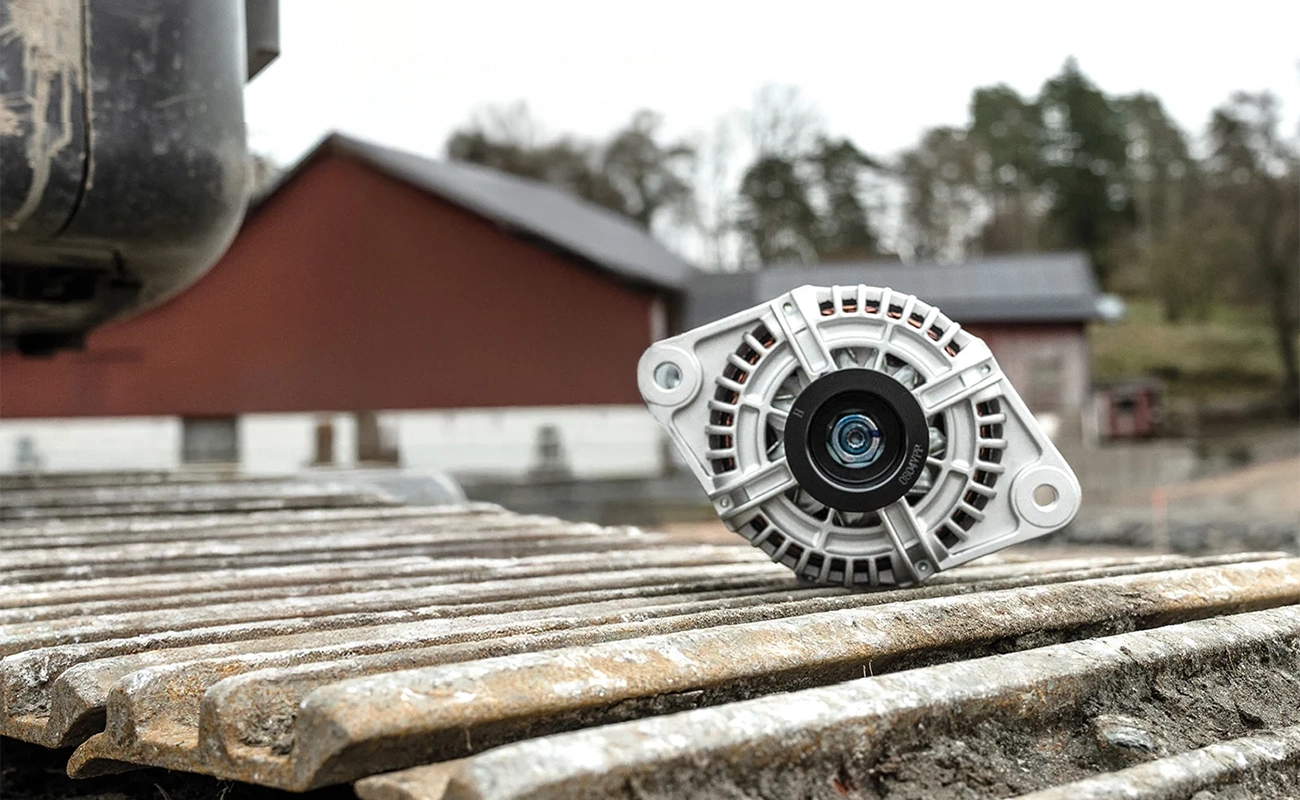
Buyer's guide – How to choose the right alternator
Choosing the right alternator is about more than a physical fit. The voltage, output, pulley type and mounting design must match your machine – otherwise it charges poorly or can't be fitted. In our guide we go through what to check, how to read markings and specifications, and how to avoid the most common wrong purchases.
See the buyer's guide
Tinkering tip – Before replacing the starter motor and alternator
Tractor mechanic Stefan Hildingsson goes through what to keep in mind before replacing the starter motor and alternator – from the signs that the part is about to give up to what you should check before you get started. Hard starting, a slow or clicking starter motor, a poorly charged battery and "dim" lights are all signals worth taking seriously.
Watch the tinkering tip
You might also like




Get news, tips and promotions – straight to your inbox
Subscribe to our newsletter and receive the latest news, promotions, and maintenance tips directly to your inbox. It’s completely free, and you can easily unsubscribe at any time.
Do you have a question?
Here we have collected common questions and answers.
Can’t find the answer to your question? Don’t hesitate to contact us!
FAQ / Frequently Asked Questions