23 October 2026
Winterising your boat engine – a step-by-step guide
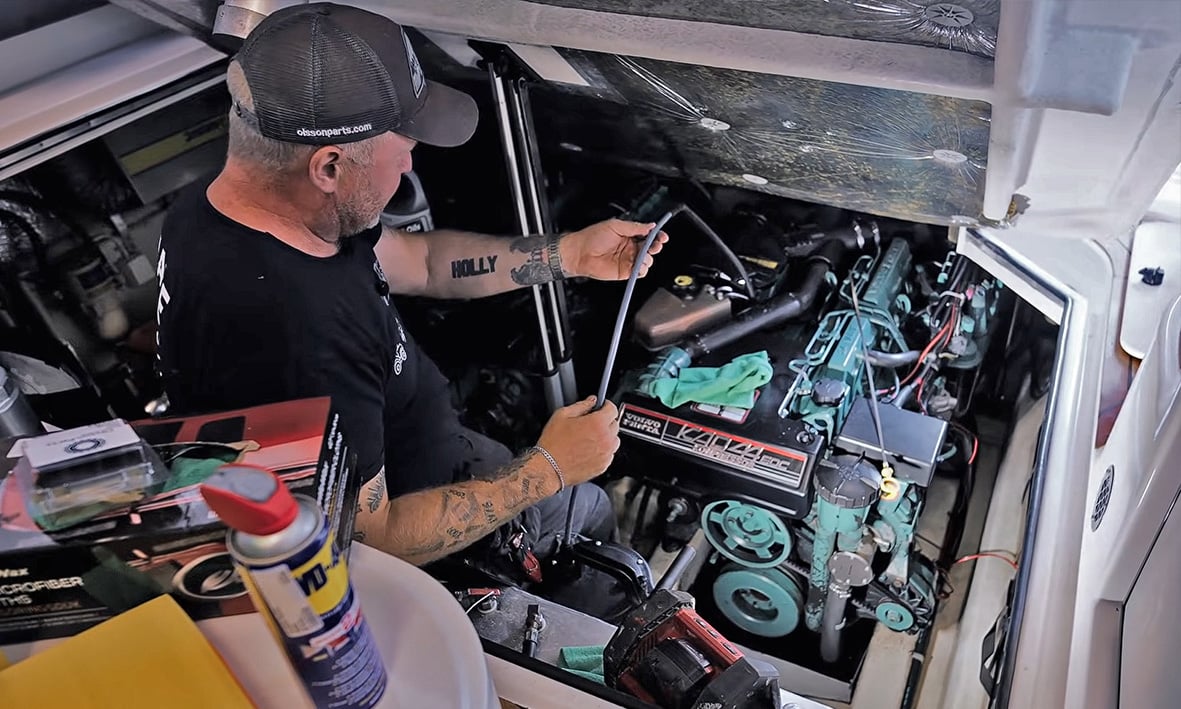
Fredrik demonstrates on a boat with an Aquamatic sterndrive. If your boat has a gearbox and propeller shaft, you connect the cooling water differently, but the basic principle is the same.
Glycol through the engine’s entire raw water system, and fresh oil while the engine is warm. That is the core of good winterising. Fredrik Vikström, product developer at Olsson Parts and a keen boater, explains how he does it – step by step, with tips that save you time now and repairs in the spring.
Fredrik’s method is based on a simple, closed loop. The engine draws a glycol mixture from a container on the bathing platform. The water exits through the exhaust bellows, where an ordinary drainpipe elbow directs it into a tub under the boat. From there, a bilge pump sends it back to the container.
Why not just connect a garden hose?
– Then you’re forcing three or four bar of pressure straight into the engine, which isn’t good. Let the raw water pump draw from the tub on its own instead. That way, it sets the pressure.
Flush and run glycol through the engine
Fredrik starts with fresh water and runs the engine for a while to flush out any dirt. Then he pours in the glycol mixture, enough to protect down to - 30 to -40°C, and lets it circulate. The first reading shows that the frost protection is too weak.
– Then you add more glycol, run it a bit longer and test again. Until you’re happy. If the boat has two engines, the same mixture will do for both. Move the setup to the second engine, top up with glycol as needed, but test again so nothing freezes and cracks over the winter. The glycol also protects against corrosion.
Change the oil and filters while the engine is warm
A warm engine is the right time for an oil change. Fredrik draws the oil out through the dipstick tube with an oil extractor. Some engines have a separate suction tube.
– Warm oil is much easier to extract. And the engine gets fresh, clean oil for the winter, which protects it well. I also change the oil filter, the fuel filters – both the fine filter and the pre-filter – and the air filter. Once that’s done, I fill up with new oil, start the engine again and run it for a while on the new oil.
Do you need to remove the drive?
The drives don’t have to come off. You can just as well trim them up, disconnect the cooling water hose and connect the hose from the tub there instead. Even so, Fredrik removes them every autumn.
– I like getting the drive off. Then I can check that the bellows are intact and the hoses are in good shape, give it a proper clean and get good access for painting. Refitting it isn’t difficult, especially if you do it every year and grease everything well. A basic service kit for the drive has everything you need.
Check the anodes
Inspect the anodes too while the drive is off. They protect the drive by corroding in its place. Worn anodes must be replaced. Choose the material based on where the boat is kept: zinc in salt water, aluminium in brackish or salt water, and magnesium in fresh water. The impeller should also be checked, but Fredrik usually leaves that until spring.
– I’m leaving the system sealed for now, since there’s glycol in it.
Final checks before winter lay-up
Finally, Fredrik goes over the rest of the engine. He checks the belts and tensioners and makes sure nothing is leaking. He charges the batteries fully, because a flat battery can freeze and crack over the winter. Fredrik recommends checking the voltage roughly every three months. He also tests the freezing point of the closed cooling system. Then he sprays WD-40 over the whole engine.
– It protects the engine, and you get a nice shine into the bargain, says Fredrik.
But the shine is just a bonus. What decides whether the engine survives the winter is something else:
– Run glycol through the entire raw water system with good frost protection, so nothing freezes and cracks. And change the oil while the engine is warm.
Fredrik’s checklist
What you need
- Tub
- Bilge pump
- Container
- Drainpipe elbow
- Glycol and antifreeze testar
- Oil extractor
- oil, fuel and air filters
- New engine oil
- WD-40
Flushing and glycol
- Let the raw water pump draw on its own – never connect a garden hose directly to the intake.
- Flush with fresh water and run the engine for a while.
- Run glycol through the entire raw water system, with frost protection down to -30 to -40°C.
- Test the frost protection, top up and test again if needed.
- Reuse the glycol for the next engine.
Oil and filters (while the engine is warm)
- Extract the oil through the dipstick tube or a separate suction tube.
- Change the oil filter, fuel filters (both fine filter and pre-filter) and air filter.
- Fill up with new oil.
- Restart the engine and let the new oil circulate.
The drive
- Remove the drive, or trim it up and connect the hose.
- Check the bellows and hoses.
- Clean and paint (never paint the anodes).
- Buy a service kit for refitting and grease well.
- Choose anodes to suit the water. Zinc for salt water, aluminium for salt and brackish water, and magnesium for fresh water.
Final checks
- Leave the impeller in place – check it in spring.
- Check belts and tensioners.
- Look for leaks.
- Charge the batteries fully.
- Does the engine have a closed cooling system? Test the coolant’s freezing point with an antifreeze tester and top up as needed.
- Spray with WD-40 for protection.